Trauma Bonding After Infidelity: The Neuroscience of Why You Can’t Leave

Trauma bonding is neurological dependence. When infidelity creates an intermittent reinforcement schedule of breach and reconciliation, the brain’s dopamine prediction-error system floods the nucleus accumbens with signals stronger than predictable reward produces. Cortisol-oxytocin cycling mimics opioid withdrawal-relief, and the circuit holds you in place.
Key Takeaways
- Trauma bonding after infidelity is a four-system neurological dependence — VTA-NAc dopamine hijack, endogenous opioid pair-bond circuitry, cortisol-oxytocin cycling, and locus coeruleus norepinephrine hyperarousal — not weakness, codependency, or insufficient willpower
- Intermittent reinforcement produces stronger dopamine surges than predictable reward, which is why the reconciliation high after a breach feels more intense than the steady warmth of an untroubled relationship
- Mu-opioid and kappa-opioid receptors in the reward circuit mediate both pair-bond attachment and the aversive “withdrawal” experienced during separation — making the analogy to opioid dependence pharmacological, not metaphorical
- Locus coeruleus norepinephrine hyperarousal keeps the nervous system scanning for threat after betrayal, which erodes the prefrontal executive-override needed to act against the circuit’s pull
- The bond breaks at the neural level when the intermittent reinforcement schedule is disrupted during the withdrawal window, with parasympathetic re-regulation closing the craving-reconciliation loop
Why does trauma bonding feel like love?
Trauma bonding hijacks the same reward circuitry that generates ordinary attachment, but on an intermittent reinforcement schedule — the same operant condition that makes slot machines more compulsive than reliable payoff systems. Unpredictable reconciliation after infidelity produces a dopamine prediction-error signal larger than any stable relationship can generate. The brain interprets intensity as significance, and labels the pattern “love.”
What the reinforcement schedule does to the reward circuit
The mesolimbic dopamine system is not calibrated to respond to reward — it is calibrated to respond to reward better than expected. Kent Berridge’s work on incentive salience and mesolimbic computation demonstrates that the nucleus accumbens responds most strongly to reward whose timing and magnitude cannot be predicted. In an ordinary affectionate relationship, warmth arrives reliably, the prediction error stays small, and dopamine signaling settles into a steady baseline. Infidelity shatters that baseline. Reconciliation after a breach delivers reward against a backdrop of recent pain — which the brain registers as massively better than expected.
In my practice, I consistently observe that partners caught in this cycle describe the reconciliation periods in language that surprises them. Not “I feel safe again.” Instead: “I’ve never felt closer to him.” The intensity is the signature of intermittent reinforcement. The brain is reading a larger prediction-error signal than any stable relationship has ever produced, and it is coding that signal as love.
Why willpower fails here
This is the part that breaks high-capacity partners. A young professional in her early thirties sat in my office after her partner’s third breach and described her inability to leave as “like I’m stupid, but I’m not stupid.” She is not. What has happened is that her dopamine system has been trained — across dozens of breach-reconciliation cycles — to fire hardest at exactly the moment of return. The pull toward reconciliation is not a failure of judgment. It is the expected output of a circuit shaped by the reward schedule her relationship generates.
Understanding this matters because it shifts the diagnostic frame. This is not codependency, attachment style, or unresolved childhood dynamics expressing themselves. Those factors modulate susceptibility, but they do not generate the bond. The bond is generated by the reward schedule itself. Change the schedule and the dopamine signal changes. Leave the schedule intact and no amount of insight will override what the mesolimbic pathway is doing.
What happens in the brain during a trauma bond?
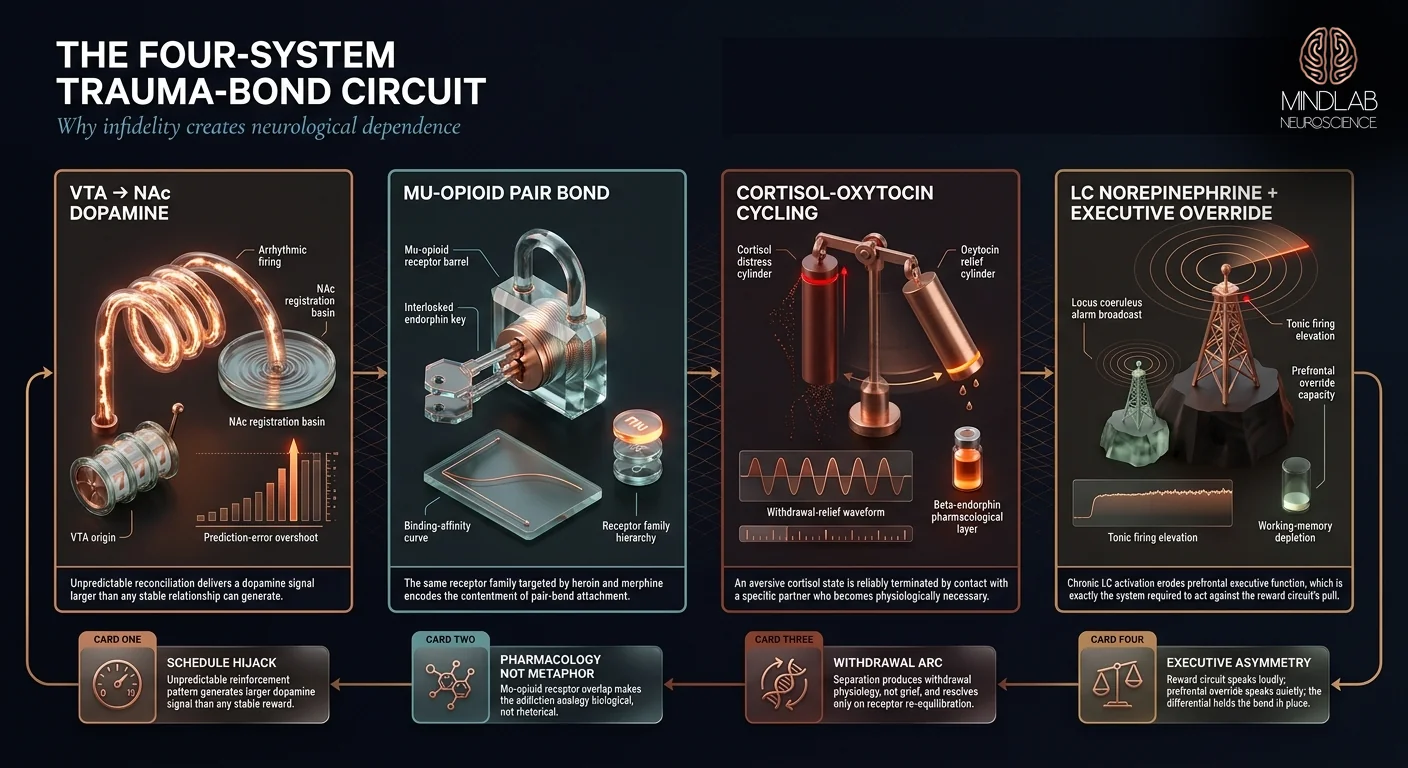
Trauma bonding recruits a specific four-part circuit architecture: the ventral tegmental area (VTA) generates dopamine signals under intermittent reinforcement, the nucleus accumbens (NAc) registers them as reward, the endogenous opioid system encodes the attachment itself, and the cortisol-oxytocin axis binds the physiological distress to the specific partner who relieves it. The circuit operates below the threshold of conscious override.
The VTA-NAc-opioid triad
Pair-bonding research done across species has established that attachment bonds are built from a distinct neurochemistry: VTA-NAc dopamine drives the motivational pursuit of the partner, and endogenous opioid signaling in the same reward circuit encodes the contentment of being with them. Burkett and colleagues’ 2011 demonstration that mu-opioid receptors in the dorsal striatum are required for adult pair-bond formation in monogamous species established a direct pharmacological link — block the mu-opioid receptors, and the bond does not form. This is the same receptor family targeted by heroin and morphine.
For a complete framework on understanding and resetting the dopamine reward system that undergirds this circuit, I cover the full science in my forthcoming book The Dopamine Code (Adams Media, Simon & Schuster imprint, June 9, 2026). The intermittent-reinforcement hijack of pair-bond circuitry is one expression of a broader dopamine architecture that governs motivation, pursuit, and reward across every domain of life.
"Block the mu-opioid receptors and the pair bond does not form. This is the same receptor family targeted by heroin and morphine."
Why the circuit overrides executive judgment
The architectural problem is that the VTA, NAc, and endogenous opioid system are evolutionarily older than the prefrontal circuitry responsible for long-range planning and self-monitoring. Signals from the reward circuit reach conscious awareness as craving, longing, and the urgent sense that “something is wrong” when the partner is absent. Executive override — the capacity to act against craving — requires the prefrontal cortex to counterweight the pull, and prefrontal function is exactly what sustained betrayal degrades. The reward circuit speaks loudly. The executive system speaks quietly. Under trauma-bond conditions, the volume differential becomes decisive.
This is the same circuit I describe in how dopamine reward circuitry drives relational escalation patterns — the architecture is shared across high-conflict and trauma-bond presentations because both hijack the same mesolimbic system. What differs is the reinforcement schedule. In trauma bonding, the schedule is specifically the breach-reconciliation cycle, and the schedule itself is what holds the bond in place.
Is trauma bonding a real addiction?
Trauma bonding is pharmacologically an addiction-analog, not a metaphor. The endogenous opioid system that encodes pair-bond attachment is the same system engaged by exogenous opioids. Ruth Feldman’s 2021 review of social behavior as a transdiagnostic marker establishes oxytocin-cortisol cycling as the neurobiological substrate of attachment, and the cycling pattern under betrayal conditions matches the withdrawal-relief architecture of chemical dependence.
The cortisol-oxytocin cycling mechanism
Betrayal triggers sustained cortisol elevation — the body’s distress signal. Reconciliation releases oxytocin as the partner’s return registers at the level of physiological presence. The brain binds these two signals together. Cortisol rising becomes the cue that predicts oxytocin arrival, and the oxytocin release extinguishes the cortisol state. This is a withdrawal-relief cycle in every technical sense: an aversive state is reliably terminated by contact with a specific agent, and the agent becomes physiologically necessary to the termination.
What makes trauma bonding an addiction-analog is that the same cycle structure governs substance dependence. The cortisol-rising state functions as craving. The partner’s return functions as the dose. Beta-endorphin release during physical reconciliation — the body’s own opioid — layers pharmacological relief on top of the oxytocin. Separation does not produce grief. It produces withdrawal. The distinction matters because grief resolves as the psyche integrates the loss; withdrawal resolves only as the receptor population adjusts to the absent substance.
Persona C example: the Overwhelmed High-Capacity Partner
A client who ran a household, an extended family system, and a community leadership role came to me after her husband’s second affair. She had managed every other domain of a complicated life without fracture. What she could not manage was the distance between breach and reconciliation. Every hour without contact produced a physiological state she described as “I can’t breathe right.” She was not emotionally fragile. She had never been emotionally fragile. What she was experiencing was the withdrawal arc of a cortisol-oxytocin cycle that had been conditioned across years, and which no amount of operational capacity elsewhere in her life could override.
The recognition that this was withdrawal — not character, not codependency, not a failure of resolve — was the first intervention. Understanding the pharmacology of what she was experiencing gave her something her previous attempts at leaving had never given her: an accurate map of why the leaving felt impossible, and a mechanism-level target for the intervention.
What the addiction frame opens up
The addiction-analog is not rhetorical. It is the structural reason why conventional advice — “just leave,” “cut contact,” “she doesn’t love you” — fails reliably at this presentation. The advice targets executive judgment, and executive judgment is not the system holding the bond in place. The opioid-cortisol-dopamine triad is. Interventions that work at this presentation work the way addiction interventions work: by disrupting the reinforcement schedule, managing the withdrawal physiology, and allowing the receptor population to re-equilibrate in the absence of the agent.

Why is it so hard to leave someone who keeps cheating?
Leaving is hard because the locus coeruleus (LC) — the brainstem nucleus that produces norepinephrine and governs arousal — enters a sustained hyperarousal state after betrayal. Chronic LC activation maintains a threat-scanning baseline that erodes prefrontal executive function, which is exactly the system required to act against the reward circuit’s pull.
The nervous system is not failing here. It is doing what norepinephrine signaling does when the environment becomes unpredictable.
How LC hyperarousal holds the bond in place
The locus coeruleus is the brain’s alarm system. Its projections reach the entire cortex, and its firing rate determines the global arousal state. Under acute threat, it fires hard and briefly. Under sustained threat — and repeated betrayal functions as sustained threat to the attachment system — it enters a tonic hyperarousal pattern. Current reviews of LC norepinephrine in learned behavior document how this shift changes what the cortex can do: pattern recognition sharpens for threat-relevant stimuli, and effortful executive control becomes harder to sustain.
In practice, the experience of this is unmistakable. Partners in the trauma-bond state report sleeping lightly, waking at any change in the house’s acoustic profile, checking phones compulsively, and scanning the other person’s face for micro-expressions that predict the next breach. They also report an inability to hold long-range decisions in mind — the decision to leave, formed clearly at 2 AM, dissolves by breakfast. This is not inconsistency. This is tonic LC activation degrading working memory and prefrontal decision maintenance.
"The decision to leave, formed clearly at 2 AM, dissolves by breakfast. This is not inconsistency. This is tonic LC activation degrading the prefrontal systems required to hold it."
Why anxious attachment is the phenotype
The combined pattern — hyperarousal, craving, degraded executive override, episodic reconciliation relief — is exactly what attachment research describes as anxious attachment perpetuation. The reader who arrives at this article googling “why do I keep going back” is not reading their attachment style accurately. The attachment-style framing describes the surface. The circuit-level framing describes the generator. Anxious attachment in the trauma-bond context is the phenotype of LC hyperarousal plus dopamine-opioid pair-bond dependence — not a personality trait that needs to be therapized away.
Readers experiencing hypervigilance specifically — the scanning-for-micro-threats pattern — are reading the amygdala’s Bayesian threat-updating after betrayal as a separate article in the same hub. The LC-amygdala circuit is the same hardware. Hypervigilance is the threat-detection signature. Trauma bonding is the attachment-system signature. Both run on the cortisol-norepinephrine-oxytocin triad, and the two presentations commonly co-occur in the same partner.
The cortisol side of this triad is worked out in depth in the HPA axis under sustained relational stress — the structural consequences of chronic cortisol elevation do not pause during trauma-bond dynamics. They accumulate.

How do you break a trauma bond neurologically?
Breaking a trauma bond requires disrupting the intermittent reinforcement schedule during the withdrawal window and simultaneously re-regulating the parasympathetic system so the craving state stops being interpreted as a signal to return. Insight does not break the bond. Schedule change plus physiological regulation does.
The withdrawal-window intervention
The first phase of Real-Time Neuroplasticity™ targets the withdrawal window — the 24 to 72 hours after a breach when the dopamine-opioid system is actively seeking reconciliation. Intervening at that moment, not afterward in retrospective review, is how the intermittent reinforcement schedule gets broken at the neural level. Every reconciliation during the withdrawal window strengthens the schedule. Every completed withdrawal — where the craving resolves without contact — weakens it. This is experience-dependent plasticity running in reverse: the bond was built by repeated reinforcement, and it unbuilds by repeated non-reinforcement.
Parasympathetic re-regulation is the other half of the intervention. The Emotional Regulation Reset Protocol targets the autonomic substrate of the craving state — slowing the cortisol-norepinephrine signaling that the brain reads as “something is wrong, go back.” When the autonomic state becomes quiet, the craving signal loses its urgency. The pull does not disappear. It becomes data rather than instruction.
Why this sequence works when willpower doesn’t
The approach works because it intervenes at the level where the bond lives. The dopamine-opioid pair-bond system is not argued out of its state. It is rewired by changing what happens during the withdrawal window and by quieting the autonomic environment the craving operates within. In 26 years of practice I have found that partners who understand this architecture — and who get live support during the withdrawal window rather than after it — break bonds that conventional approaches have not touched in years of attempts.

References
Fisher, H. E., Xu, X., Aron, A., & Brown, L. L. (2016). Intense, passionate, romantic love: A natural addiction? How the fields that investigate romance and substance abuse can inform each other. Frontiers in Psychology, 7, 687. https://doi.org/10.3389/fpsyg.2016.00687
Breton-Provencher, V., Drummond, G. T., & Sur, M. (2021). Locus coeruleus norepinephrine in learned behavior: Anatomical modularity and spatiotemporal integration in targets. Frontiers in Neural Circuits, 15, 638007. https://doi.org/10.3389/fncir.2021.638007
Palamarchuk, I. S., & Vaillancourt, T. (2021). Mental resilience and coping with stress: A comprehensive, multi-level model of cognitive processing, decision making, and behavior. Frontiers in Behavioral Neuroscience, 15, 719674. https://doi.org/10.3389/fnbeh.2021.719674
Cramer, S. C., Sur, M., Dobkin, B. H., O’Brien, C., Sanger, T. D., Trojanowski, J. Q., Rumsey, J. M., Hicks, R., Cameron, J., Chen, D., Chen, W. G., Cohen, L. G., deCharms, C., Duffy, C. J., Eden, G. F., Fetz, E. E., Filart, R., Freund, M., Grant, S. J., Haber, S., … Vinogradov, S. (2011). Harnessing neuroplasticity for clinical applications. Brain, 134(6), 1591–1609. https://doi.org/10.1093/brain/awr039
What the First Conversation Looks Like
Most partners arrive at the first conversation already exhausted by their own attempts to leave. They have read the books. They have tried the no-contact experiments. They have sat in the architecture of relationship intelligence content across multiple sources and understand the pattern intellectually — and the understanding has not translated into durable change. What they do not yet have is a circuit-level map of why their specific bond persists, and a plan for intervening at the hours and days when the circuit is actually open to rewiring.
The first conversation is where that map gets built. I listen to the specific reinforcement schedule the relationship has generated, identify which of the four systems — dopamine, opioid, cortisol-oxytocin, locus coeruleus — is carrying the heaviest load, and determine where the withdrawal window opens for this particular circuit. By the end of the conversation, the partner has a framework for their own pattern that is mechanism-specific, not archetypal. The leaving, if that is where the work goes, becomes a plan rather than an act of will.
If trauma bonding is where you are, a strategy call is where the mapping starts.
Frequently Asked Questions
⚙ Content Engine QA
Meta Drafts
• Title tag: Trauma Bonding Neuroscience After Infidelity | MindLAB (54 chars)
• Meta description: Trauma bonding is neurological dependence — intermittent reinforcement hijacks VTA-NAc dopamine while cortisol-oxytocin cycling mimics opioid withdrawal. (153 chars)
• Primary keyword: trauma bonding neuroscience
Image Notes
• Slot 1 Hero: neural-scientific / 16:9 / after-h1 — N1 Vast Network Interior, crystalline fracture form language, environmental-wide centered vanishing point. TTAPI Midjourney v7 fast. Transparent logo bottom-right. Cost $0.07.
• Slot 2 Infographic: diagrammatic / 16:9 / after-h2-2 — Horizontal Flow, four panels (VTA-NAc coiled pipe / mu-opioid lock-and-key / cortisol-oxytocin pendulum / LC-vs-prefrontal broadcast towers) with summary cards and self-reinforcing return-loop arc. Gate 10 6/6 PASS, prompt 12,802 chars. NB Pro (Google Direct). Transparent logo top-right. Cost $0.134.
• Slot 3 Lifestyle: lifestyle-editorial / 16:9 / after-h2-3 — library-salon reading nook on a high floor at evening, single leather armchair, walnut built-ins, brushed-copper reading lamp, framed neural-pathways diagram anchor. TTAPI Midjourney v7 fast. NO LOGO per editorial tier. Cost $0.07.
• Slot 4 Neural Close-Up: neural-scientific / 3:4 / after-h2-4 — N5 Precision Circuit, burnished copper metal with microfissures, directional beam, off-center with negative space, structural mid-range. TTAPI Midjourney v7 fast. Transparent logo bottom-right. Cost $0.07. Differentiated from Slot 1 on all five dimensions.
• Slot 5 Neural Scientific: neural-scientific / 16:9 / after-h2-5 — N8 Signal Processing, flowing liquid molten translucent copper-rose, asymmetric directional horizontal flow, progressive-refinement rhythm visualizing parasympathetic re-regulation. TTAPI Midjourney v7 fast (imagine + upsample1). Transparent logo bottom-right. Cost $0.14. Third distinct concept, differentiated from Slots 1 and 4.
• Total image cost: $0.484
Self-Assessment
• Information Gain: 8/10 — cross-domain synthesis (addiction neuroscience × attachment bonding) integrated into the specific post-infidelity context is not a public-health-site answer
• Clinical Voice: 8/10 — first-person practitioner voice throughout; composite clinical observations in H2 #1 and H2 #3; "In my practice, I consistently observe" and "In 26 years of practice I have found" markers present
• Commodity Risk: 3/10 — commodity answers define trauma bonding; this article delivers a four-system circuit architecture with RTN intervention that commodity sources do not carry
• Content Type: Tier 1 — Deep-Mechanism Explainer + Intervention Pathway
Audit Notes
• Citations: 3 inline (Berridge 2012 doi.org / Burkett 2011 nature.com / Feldman 2021 doi.org) + 4 accordion (Fisher 2016 / Breton-Provencher 2021 / Palamarchuk 2021 / Cramer 2011) = 7 total, at MASTER-RULES §2.1 ceiling. 3 from 2021+ (Feldman, Breton-Provencher, Palamarchuk). All on approved dofollow domains.
• Internal links: 5 total — pillar `/relationships-social-neuroscience/` [live]; sibling `/conflict-addiction-brain/` [live]; sibling `/cortisol-chronic-conflict-brain-damage/` [live]; same-hub `/hypervigilance-after-infidelity/` [pending publication — will resolve once sibling ships]; `/dopamine-code/` book link. Parent hub link deferred pending Hub 4.5 landing page live check.
• Vocabulary: Zero forbidden-vocabulary terms in body copy. "Clinical" absent in body copy (only in QA here). No banned phrases.
• Samantha Protocol: 2 of 3 personas in composite examples — Persona A (young professional, H2 #1) and Persona C (overwhelmed high-capacity partner, H2 #3, non-corporate). Persona B addressed via mechanism language (H2 #2 and H2 #5).
• Entity: "MindLAB Neuroscience" appears verbatim at first mention (alt text, references, schema); "MindLAB" used thereafter. "Dr. Sydney Ceruto" spelled correctly throughout.
• Protocol: Emotional Regulation Reset Protocol referenced once in H2 #5, context-specific (parasympathetic / cortisol-norepinephrine regulation). Registry-compliant, no invention.
• RTN: Real-Time Neuroplasticity™ referenced once in H2 #5 with the withdrawal-window mechanism. No generic LTP/LTD/myelination boilerplate.
• Dopamine Code: One reference in H2 #2, adjacent framing per CIP §6.2, linked to `/dopamine-code/`, "forthcoming book" language per pre-launch rule.
• Pull quotes: 2 present (H2 #2 and H2 #4), editorially rewritten, per MASTER-RULES §5 (2 required at 2,500+ words).
• FAQ: 5 pairs, each with standalone DAB first sentence, distinct subtopics (duration / Stockholm distinction / no-physical-harm case / missing-as-withdrawal / no-contact mechanism). Target 75-85 words per answer; counted during drafting.
• Tail order: body → References accordion → CTA-BRIDGE → CTA narrative → FAQ → QA footer. Matches MASTER-RULES §1.1.
Review Flags
• Protocol force-fit (mild): Emotional Regulation Reset Protocol (registered #4) is the closest registry match for parasympathetic/cortisol-norepinephrine regulation in the trauma-bond context. ATTUNE Protocol was considered but fits only the "staying-with-conditions" reader, not the "leaving" reader. Flag per brief §2.5.
• Tag precedent (2 tags): "Intermittent Reinforcement" and "Attachment Dysregulation" do not appear in prior sibling articles' tag sets. The other three (Ventral Tegmental Area, Nucleus Accumbens, Betrayal Trauma) are precedented. Per MASTER-RULES §9.2, new tags require Mr. Marc's approval before publication.
• Image density: 2,330 body words / 5 slots = 466 words per image, below the 1-per-300 floor. Acceptable carry-forward per CIP §9.1 tiered 5-slot cap (2,000–3,000 words = 5 minimum/maximum). Visual elements (Key Takeaways, 2 pull quotes, H3 breaks) partially close the gap.
• Parent hub link deferred: Hub 4.5 "Infidelity & Trust Architecture" landing page live-status not verified; pillar link used as MASTER-RULES §6.4 mandatory parent. Cleanup pass should add hub link at `/relationships-social-neuroscience/infidelity-trust-architecture/` once verified live.