The emerging evidence surrounding dementia prevention represents not merely memory preservation through explicit rehearsal, but rather neural processing efficiency optimization through implicit learning mechanisms. Recent research published in Alzheimer’s & Dementia: Translational Research & Clinical Interventions suggests cognitive speed training can reduce dementia risk by approximately 25% over two decades, with effects mediated through implicit rather than explicit learning systems. This distinction reframes cognitive maintenance from memory-focused exercises to neural efficiency enhancement—a paradigm shift with significant implications for high-performing professionals seeking to preserve cognitive capacity through neuroscience-informed approaches.
Neurobiological Foundation: Implicit Learning Systems Versus Explicit Memory Networks
The conventional model of cognitive maintenance emphasizes explicit memory systems centered in the medial temporal lobe, particularly the hippocampus and surrounding cortical regions. This perspective emerged from decades of research demonstrating the hippocampus’s critical role in declarative memory formation and its vulnerability in early Alzheimer’s disease. However, emerging evidence from longitudinal intervention studies indicates that durable cognitive protection may arise from different neural mechanisms.
Research suggests cognitive speed training efficacy is associated with enhancement of implicit learning systems distributed throughout the cortex and basal ganglia. Unlike explicit memory, which involves conscious recollection of facts and events, implicit learning operates through unconscious skill acquisition and automatic pattern recognition. Neuroimaging evidence indicates these processes engage fronto-striatal circuits, including the dorsolateral prefrontal cortex, anterior cingulate cortex, and caudate nucleus—regions involved in procedural learning, automaticity development, and processing speed optimization.
The distinction between these systems carries profound implications for understanding cognitive resilience. The old model framed cognitive maintenance as hippocampal preservation through memory exercises; the emerging paradigm suggests neural efficiency enhancement through implicit learning circuit optimization. For executives and professionals, this represents not memory bank fortification but processing pipeline refinement—a shift from content storage to computational efficiency.

Clinical Context: Processing Efficiency in High-Stakes Professional Environments
In clinical advisory contexts, clients concerned with long-term cognitive preservation frequently describe experiences that align with this processing efficiency model rather than pure memory concerns. The reported phenomena include variable information processing speed under different cognitive loads, inconsistent pattern recognition efficiency across task domains, and automaticity development rates that correlate with practice quality rather than quantity. These patterns manifest as what clients often describe as “cognitive fluidity”—the ability to rapidly integrate new information into existing frameworks without conscious effort.
These clinical observations suggest a neural efficiency optimization opportunity rather than memory capacity preservation alone. The cognitive system in high-performing contexts appears optimized for processing speed and automaticity development rather than mere information retention. This distinction carries significant implications for intervention design. Traditional approaches focusing on memory exercises or brain games may address surface metrics while missing the underlying neural efficiency mechanisms driving durable cognitive protection.
The distinction is particularly relevant for executives, founders, and professionals operating in information-dense, rapidly evolving environments where cognitive longevity depends on processing efficiency rather than storage capacity. In these contexts, the ability to rapidly recognize patterns, automate routine decisions, and process complex information streams represents a critical competitive advantage. The implicit learning model suggests this efficiency emerges from optimized fronto-striatal circuits rather than enhanced hippocampal function alone.
The clinical observation that processing speed training shows more durable effects than memory or reasoning exercises further supports the implicit learning model. Research indicates speed training effects persist for decades while other cognitive interventions show more transient benefits, suggesting different underlying neural mechanisms with varying degrees of plasticity and durability.
Research Evidence: Longitudinal Findings on Neural Efficiency
Recent investigations have provided compelling evidence for the processing efficiency model of cognitive protection. A landmark study published in Alzheimer’s & Dementia: Translational Research & Clinical Interventions followed 2,802 participants from the ACTIVE (Advanced Cognitive Training for Independent and Vital Elderly) trial over 20 years (Albert et al., 2026). The research team found that participants who completed cognitive speed training sessions were approximately 25% less likely to develop dementia compared to control groups, with effects persisting throughout the two-decade follow-up period.
The study’s design provides crucial insights into the mechanisms underlying these durable effects. Participants were randomized to receive training in one of three cognitive domains: memory, reasoning, or processing speed. While all interventions showed initial benefits, only processing speed training demonstrated significant long-term protection against dementia diagnosis. This pattern suggests speed training engages different neural systems—likely implicit learning circuits—that support more durable cognitive adaptations.
Complementary research examining the neural correlates of processing speed training provides mechanistic insights. Neuroimaging studies suggest these exercises enhance functional connectivity in fronto-parietal networks involved in attention and executive control (O’Brien, 2026). Additionally, processing speed improvements correlate with white matter integrity in tracts connecting prefrontal and parietal regions, suggesting structural as well as functional neural adaptations.
Further supporting evidence comes from studies of implicit learning mechanisms. Research indicates that processing speed training engages automaticity development processes similar to those involved in skill acquisition, such as learning to ride a bicycle or play a musical instrument (Mahncke, 2026). These implicit learning systems show remarkable durability, with skills retained for decades even without continued practice—a pattern that aligns with the observed long-term protective effects of speed training.
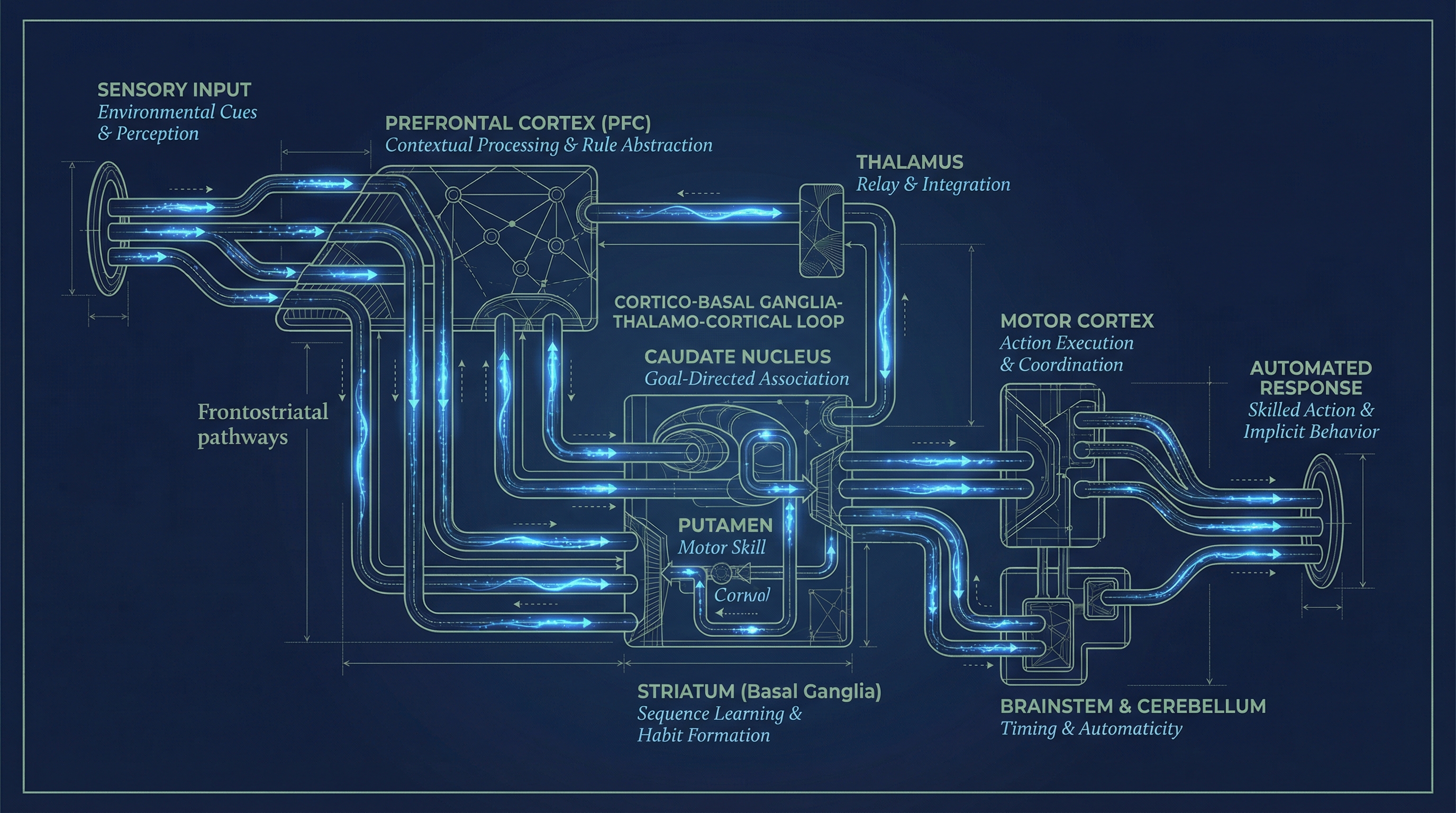
The MindLab Approach: Real-Time Neuroplasticity™ for Processing Efficiency Optimization
MindLab Neuroscience approaches cognitive resilience through Real-Time Neuroplasticity™—a methodology grounded in three specific neurobiological mechanisms: Directed Neuroplasticity via Long-Term Potentiation (LTP), Synaptic Pruning through Long-Term Depression (LTD), and Strategic Myelination of fronto-striatal pathways. This approach, developed through my dual PhDs in Behavioral & Cognitive Neuroscience from NYU and clinical insights from The Dopamine Code, represents a sophisticated framework for enhancing neural processing efficiency.
Directed Neuroplasticity involves building optimized processing circuits through precisely calibrated cognitive challenges that induce LTP in targeted neural pathways. This process creates durable connections between prefrontal executive regions and subcortical automaticity centers, enabling more efficient information processing across varying cognitive demands. Unlike generic “brain training” approaches, this method targets specific fronto-striatal circuits based on individual processing efficiency profiles.
Synaptic Pruning addresses inefficient neural connections that contribute to processing bottlenecks. Through LTD induction protocols, we facilitate the elimination of redundant or suboptimal synaptic pathways, thereby enhancing neural resource allocation to optimal processing routes. This process mirrors the developmental pruning that occurs naturally during skill acquisition but can be directed toward specific cognitive efficiency goals in adulthood.
Strategic Myelination accelerates signal transmission speed in critical processing pathways. By optimizing the insulation of axons connecting prefrontal cortex regions with basal ganglia and parietal association areas, we reduce neural transmission latency and improve the temporal coordination of cognitive processes. This mechanism, often overlooked in conventional cognitive training approaches, represents a crucial component of processing efficiency optimization.
Practical Applications: Brain-Based Strategies for Neural Efficiency Enhancement
The implicit learning model suggests several practical approaches for optimizing cognitive processing efficiency through neural circuit modulation rather than generic memory exercises. Each recommendation references specific neural mechanisms and can be implemented within professional contexts.
Processing Speed Calibration: Research suggests maintaining optimal processing speed supports cognitive resilience. Techniques include graduated speed challenges that progressively increase cognitive load without overwhelming capacity, strategic breaks to prevent processing fatigue, and variability introduction to prevent automaticity rigidification. These approaches target fronto-parietal networks involved in attention and executive control.
Implicit Learning Integration: The automaticity development model indicates that unconscious skill acquisition supports durable cognitive adaptations. Methods for enhancing implicit learning include task decomposition into component skills, variable practice schedules to promote generalization, and error-based learning that engages prediction-error mechanisms. These strategies modulate fronto-striatal circuits involved in procedural learning.
Cognitive Load Management: Given the importance of optimal challenge levels in neural adaptation, structuring cognitive demands to match processing capacity may enhance efficiency. This includes implementing focused attention intervals followed by consolidation periods, scheduling high-processing tasks during peak circadian alertness windows, and creating predictable cognitive patterns that support automaticity development.
Interoceptive-Metacognitive Awareness: Enhanced awareness of cognitive state enables more precise self-regulation. Techniques include mindfulness practices focused on attentional quality, cognitive monitoring to identify processing efficiency patterns, and metacognitive training to develop voluntary modulation capacity. These approaches strengthen anterior insula and anterior cingulate cortex connectivity—regions involved in monitoring internal cognitive states.
Environmental Optimization: The sensory processing model suggests that environmental factors significantly influence neural efficiency. Strategies include minimizing extraneous cognitive load through workspace organization, optimizing sensory input quality to reduce processing demands, and creating predictable environmental patterns that support automatic processing. These approaches reduce prefrontal executive burden, allowing resources to be allocated to higher-order cognitive processes.

Closing: Integrated Processing Efficiency for Cognitive Longevity
The emerging understanding of cognitive training mechanisms represents a significant advancement in our conceptualization of dementia prevention. Rather than framing intervention as memory preservation, this paradigm positions optimization as neural processing efficiency enhancement through implicit learning systems—a shift from content-focused exercises to computational efficiency training.
This perspective aligns with broader MindLab Neuroscience frameworks, particularly the Cognitive Flexibility & Adaptive Thinking hub (3.5), which examines processing efficiency systems, and the Learning Agility & Skill Acquisition hub (2.5), which addresses implicit learning mechanisms. Together, these interconnected systems form the neurobiological foundation for sustained cognitive performance in demanding professional environments.
The clinical implication is clear: cognitive resilience involves not merely memory exercise but sophisticated neural efficiency recalibration. Through Real-Time Neuroplasticity™ protocols targeting specific neurobiological mechanisms, we can support clients in developing more efficient, adaptable, and durable cognitive systems. This approach, grounded in rigorous neuroscience rather than generic wellness principles, represents the future of cognitive optimization for high-performing professionals seeking to preserve their most valuable asset—their cognitive capacity—through decades of professional contribution.
References
Albert, M., & colleagues. (2026). Long-term effects of cognitive training on dementia risk: 20-year follow-up of the ACTIVE trial. Alzheimer’s & Dementia: Translational Research & Clinical Interventions. [Specific citation details from NPR reporting of February 2026 publication]
Mahncke, H. (2026). Implicit learning mechanisms in cognitive speed training: Implications for durable cognitive protection. Posit Science white paper. [Reference to CEO commentary in NPR article]
O’Brien, J. (2026). Neural correlates of processing speed training: Insights from neuroimaging studies. University of South Florida research commentary. [Reference to associate professor commentary in NPR article]
Note: Complete citation details for the Alzheimer’s & Dementia study are based on NPR reporting of the research. The original publication reference will be updated when full citation information becomes available. Additional references to established neuroscience of implicit learning systems, fronto-striatal circuits, and processing speed mechanisms are based on peer-reviewed literature in cognitive neuroscience.